Showing posts with label ecosystems. Show all posts

Sunday, January 1, 2023

Aligning with Life: a Spiritual Response to Climate Crisis

I was reading an essay, To Take Wilderness in Hand by Michelle Nijhuis, in the book Old Growth.  The essay is about the controversy among restoration experts and Native planet advocates about whether to simply restore or "migrate' endangered species of trees, insects, birds and animals.  For many, many decades the position of both has been that "right plant in right place" meant only native plants that grew here before western contact.  We have all seen the havoc an invasive plant causes, right?   And fundamental to that is understanding that the plant is not destructive in its own native habitat.  But transplanted it does not have natural predators or other factors that limit it.  It can over run other plants and take sun and water from them and destroy balance.  We all know how transported insects have devastated whole forests who had no defense against them and no natural predator birds- and thus killing trees wildly.

This becomes even hotter debate when you start talking about animals and birds (and insects) being moved around or creating mitigation areas for them.   Many of the efforts to simply move animals to suit humans have failed miserably resulting in the death and even extinction of the animal species.   But also moved animals have wound up without predators ravishing the area they moved to.  The removal of predator species like wolf, coyote or bear have led to the gross over population of species they prey upon like deer or rabbits to the point that those animals then destroyed the local flora and fauna because things were so out of balance.  (Equally dramatic stores about the restoration of a whole ecosystem when those animals - wolves or buffalo were reintroduced where they had been.)

Therefore, naturalists have generally just taken the position that we should not be intervening - not transplanting plants, or moving animals, or removing ones we don't like...that we should leave nature to her own rebalancing methods.

However, now climate change has gotten so bad, so a new debate is taking place.   Particularly about trees that normally migrate to different temperature zones very slowly (by decades) by birds dropping seeds some score of miles away and the tree growing there and reproducing.   This is neither the speed nor distance that would allow them to migrate out of severe climate change.   Because a state 100 to 200 miles north may in fact come to have the same weather conditions that historically its neighbor to the south has had before climate change, some restoration specialists are now recommending trying to wholesale move species north to try to save them.   As we are also experiencing mass extinctions happening of many species greatly exasperated by climate change there are similar conversations about whether moving animals will be a necessity and what do we owe them given what we have done to their liveable environment?

As I read this essay, I felt deeply conflicted.  I have been in the "don't mess with things - God already created perfection" camp.  Aware that we have only unbalanced that perfection.  But the idea of no longer having any CA Redwoods is certainly unbearably sad.   What do we owe other species in the mess we have made?   Will trying to correct only create new unforeseen problems as has tended to happen with our interventions.  Even with the best science available to us - how would we not just screw it up more?  The article mentioned that in early attempts already made some succeeded and some failed.  In Diana Beresford-Kroger's autobiography she mentions her current project of bringing all rare nearly extinct trees to her property in CA to try to preserve them.   Her journey to find them has been remarkable and some last living species she found not in their tradition areas but where someone had transplanted the plant elsewhere, and it has survived therefore pests or blight. 

I lay meditating upon this and what came to me was a great surprise but did align with the notion of living in reciprocal relationship with plants and animals.   I thought about how Native people ask plants permission to harvest them and in other ways try to tune into them and listen to what they have to say.  It occurred to me that before these sorts of interventions could happen only if someone with the right skills first tuned in and asked if the plant or animal wanted to be moved.   Then if the answer to that was yes, a relationship of empowering service to the plant would need to take place.   The human moving it would literally have to listen to its guidance - its yes or its no about the location into which it would be relocated.

I realize for some this will be seen an idea way to airy fairy.   But for those that have followed the most recent science showing how plants and trees communicate with each other, and the great complexity of qualities that makes friendly habitat...it is not farfetched to say that a plant knows what it needs.

But what I am particularly struck by here is that this is a profound form of aligning with life this is - of coming into relationship with plants and animals in a way that respects their nature and their intelligence.   This is not a new concept for indigenous people but for western science this is an anthropomorphic approach to things.  Given the glaring failures of western science and the centuries of stewardship of Earth by Indigenous people we would do well to respect such approaches.

But beyond that it points powerfully to the way we need to conduct ourselves to start to stop and repair climate change.   We must align with life's longing for life itself.  Joanna Macy has always said Earth is on our side.  Earth also is fighting for survival.   But the Creator most certainly has programed everything to support life.  This is in fact the only way to be in reciprocal relationship with Earth - is to be in alignment with life itself.  To just serve life.  This is the only road map we need for how to fight for the life on this planet - is to align with life.


Monday, February 28, 2022

Beyond policy to paradigm shift

 After my work with 350Seattle.org and Faith Action Climate Team when I moved to Olympia I worked for two and half years for Thurston Climate Action Team (TCAT).  TCAT is very focused on policy work and specifically on getting our county to pass a climate mitigation plan.  What was exciting to me about this was that the creation of this plan involved the three tri-cities of our county and the county itself.  This is unusual - usually only a city or a county makes a plan.  There seemed a rare opportunity to do something much more effective.  Unlike some plans that were unbenchmarked this one was intended to be benchmarked with implementable steps, and with an analysis of equity issues and the costs of various different steps in the plan.   It was envisioned that this plan could be a model for other communities of this size which studied showed was the "sweet spot" in size of community (around 100,000 in population) for social change.

In reality as the process meandered on the hours and therefore the budget was used up so that the plan was created without benchmarks, implementation steps, equity analysis or budget analysis.  Once all the jurisdictions finally passed it, the slow walking began.  It had passed right after workplans and budget for the year had just passed and thus only one jurisdiction had hired a staff person to implement the plan and this hamstrung the other three throughout the year.  As the year dragged on literally only 1 of the 72 items was implemented (by the county - an item which only they had to do.)   As conversations took place between TCAT and local officials on policy items which were being acted upon which did intersect with the plan we found that the jurisdictions were on much of the same projectory that they were on before the plan was passed.   Maddeningly one of the jurisdictions actually passed an "update" to one of the items in the plan which actually moved them backwards!   This occurred with no recognition on their part that this had anything to do with the plan and when pointed out by the public this was ignored. 

Thurston county is different than large county's like King county, elected officials here are unpaid and almost all of them hold other regular jobs and this is a part time and secondary job for them.  What this means is that they rely heavily on the paid city staff to carry out and prepare the work of the jurisdiction.  It also became clear that the unelected staff brought various biases and also business as usual ways of approaching these things.   Both elected officials and staff are use to many steps and phases, intensive planning and a no deadline process for getting things done.   At one point the consultant had said they would need to "aggressively" implement the plan and they were asked what that would mean?  He said hesitantly "Well much more urgently that local governments usually do things."   That was an understatement!   This in fact became the central problem - despite 3 of the four also passing a climate emergency declaration at the same time....they do not act as if any emergency is happening.

This is in part why I left TCAT - it became too frustrating to regularly sit down like Alice in Wonderland to the Mad Hatter tea party.  But I learned some important things from this experience.  Fredrick Douglas famously said:  "Power never concedes anything without a demand.  It never has and it never will."   Einstein also famously said:  " We cannot solve a problem engaging in the same thinking that got us into the problem."  I am crystal clear now having been through a similar story in the effort to get the City of Seattle to divest its pension, and to pass an ordinance protective of its trees that no matter how "progressive", nor whether local gov, county, state or national...our elected bodies are not going to make policies that change our climate picture until we as a people make a paradigm shift and then DEMAND a change.  Until we as a people understand we are part of Earth, interdependently locked into the same reciprocal ecosystem we will not behave differently or make different policy decisions.  The real work of climate activism - is movement building - is paradigm shift.  It is helping us as a people move into relationship with our air we breath, our water we drink and our Earth we stand on and call home!


Sunday, March 28, 2021

Old Paradigm to New Paradigm

 The old paradigm is very familiar to you.  You grew up with it expressed all around you in thousands of ways: literature, movies, news stories, products, advertising, mythology...essentially from all venues that program your brain.  It is the belief that humans are the dominant species on the earth.  That we are superior to all other species and that we are hear to have "dominion" over the earth and all the fruits of the earth.  As Riane Eisler said decades ago in the Chalice and the Blade, it is the dominator model.  It runs throughout the Old and New Testament but also all of Western History.  It's foundations were well rooted in the original Decartian error: the idea that the body is separate from the spirit. The breaking down of our world into parts rather than seeing it a complex interdependent whole.  This dominator model also underlies the origins of empire and racism and classism and sexism and all other isms.  This model always divides: into "good" and "bad" but fundamentally into oppressor and oppressed. 

This old paradigm also inevitably resulted in climate change.   Because how could we not, if we believe we are the dominate species, here to rule earth, not think it was therefore ok to take from earth, to mine and to plunder, and to pollute and to throw away and to desecrate earth?  When one really exams our climate crisis it is very, very clear we do not have 1 crisis.  We do not have a crisis simply of a globe that is warming, or of GHG that has somehow magically increased.  Even when you grant without contest that humans are responsible for the crisis, that fails to cover the magnitude.   No when you look closely enough you begin to realize that it is knit into how we produce energy, how we construct buildings, how we transport ourselves, how we farm, how we mine resources, how we manufacture goods....basically how we do everything that we do.  And this because we are operating off of the old paradigm.  This paradigm has always created without consideration for how we impact earth or other living beings around us.  As my native friends say:  "It took you only 300 short years to ruin paradise".

We will not stop climate change by stopping fossil fuel extraction (although that would be a good start).  We will not stop climate disaster by stopping our GHG emissions, nor will end the chaos by banning together in treaties or making mitigation plans.   All are necessary and good, but we will not be able to do any of those things unless we achieve a radical deep complete, worldwide paradigm shift.  We will not be able to plan our own salvation until we can think differently about the very problem and recognize accurately how we got here.

In the new paradigm, first and foremost we will have to give up the notion of human exceptionalism.  We will have to give up the idea of having dominion over the earth or other sentient beings.  We will need to notice and embrace on the deepest level possible that we are part, a very small part, of a whole system.  We will have to see the rest of the Life on this planet as our brothers and sisters, to whom we are bound in a complex and interdependent system.  We will have to understand whole systems and the rules of whole systems.   We will need to get out of the way of Earth's own corrective mechanisms.  We will have to realign with life systems rather than trying to control or manipulate or engineer those systems.   We will have to have the humility to admit the huge disastrous mistakes we have made trying to play God with our ecosystem.  We will need to pay attention and start learning from and about our ecosystem.  We will have to learn awe and gratitude for its original perfection.  We will have to come back into alignment with life.


Sunday, November 29, 2020

The Truth about Trees

 I am sitting through another meeting where someone is saying that it is ok about the trees being cut down because there will be replacement trees planted.  I sigh.  I have come to learn that our public education system teaches people nothing about trees, and thus most people know nothing about them.   Most of us cannot identify anything but the most basic trees a Maple, an oak or an "evergreen" (which is really many many trees which we are lumping into one category.)   We view trees as pretty, and practical - meaning they are good for building stuff and making paper.  But because they can "grow again" we think nothing of cutting them down.

Here is a list of some of the things I wish people understood about trees:

Trees Improve Air Quality by removing pollutants

Lower Asthma Rates

Studies show lower rates of Asthma in neighborhoods with greater tree density.  Low income neighborhoods tend to have fewer trees making this an equity issue.

Prevent Heat Islands

Cities can be 12F higher than other areas because of density.  Under climate change this can be fatal.

Lower Heating and Air Conditioning Bills

Trees provide cooling benefits in the summer and wind-chill reduction in the winter resulting in energy savings in nearby buildings. Olympias street trees in 2019 alone provided energy savings of 785,00 about $330 per building.

Storm Water Retention

Trees reduce and slow stormwater by intercepting rain in their leave and branches.  It is soaked up by tree roots rather than runoff from streets and sidewalks.   This can help prevent flooding, stream bank erosion, habitat destruction, sewer system overflows and contaminated water bodies.  The technological ways of managing storm water are expensive!

Drought Prevention

By roots drawing water into the ground they help lessen the impacts of drought.  This will increasingly matter with climate change.

Wildlife and Insect Habitat

Trees provide critical habitat for birds, mammals and insects.  Part of the loss of bird diversity is attributed to loss of habitat.

Mental Health benefits from proximity to trees

Studies show lower levels of depression if people can even see a tree out their window.

Aesthetics/ increase property values

We of course find trees beautiful but that beauty also translates into higher property values.

 Carbon sinks

Trees absorb carbon dioxide from the atmosphere.  The carbon is stored in its roots and in the soil, thus reducing carbon emissions in the air (carbon sequestration.) Carbon sequestered in this way helps to maintain and regenerate the surrounding community of trees and other plants. As long as the tree is allowed to live, it continues to store carbon and keep it out of the atmosphere.  When it is cut, according to the Sierra Club, 60% of the stored carbon is immediately released to the atmosphere – the rest depends upon how the tree is used.

Trees take in Co2, a greenhouse gas, and, in exchange, they transpire oxygen which we breathe.  Street trees in Olympia collectively sequester more than 420,000 pounds of carbon every year (~2 metric tons).  Each street tree on average has stored over 2,000 pounds of carbon over its lifetime and continues to store carbon as it grows.  Street trees in Olympia have stored more than 5 million pounds of carbon!

Zarghami, H. An Ecosystem Assessment of Olympia’s Street Trees. Evergreen State College. 2020.

Thus when we talk about cutting down trees we must understand we lose their stored carbon and we lose their annual drawdown capacity and we lose all their future annual drawdown which would occurred till the end of the trees natural life which for many species is longer than a human life.

The IPCC’s most recent report has said that we can no longer globally avert disaster by reducing emissions alone.  It has stated that we must aggressively plant trees world wide in order to increase our capacity to sequester GHG’s.   

All trees are not equal (and this is why I wince in those meetings where they talk about cutting down a great big tree and replacing it with a sapling)

A 30” tree provides 70% more “environmental services” than a 3” tree.

The following table shows Carbon Sink or Sequestration per EPA data:

From the EPA

Hardwoods

conifers

1 year old tree

1.6 to 4 lbs carbon/per tree/annually

.9 to 2.2 lbs carbon/per tree/annually

35 year old tree

20 to 79.3 lbs carbon/tree/annually

15 to 65 lbs carbon/per tree/annually


This is critical to understand since typically developers give lip service to the cutting of trees by saying they will plant replacement trees.  Even when they plant the same number (which is rare) they are not replacing the level of environmental services those trees were providing.  To cut down even one 30” tree would require replanting with 70 3” trees to drawdown the same amount in the next year.  That is why they are called Exceptional trees.  They are irreplaceable.  It takes about a 100 years (depending upon species to achieve that same level.

One of my friends wanted her neighbor to cut down a 100 year old tree in their yard to improve her view.  I said: "Respect your elders...that tree has lived way longer than you".   She thought I was making a joke.  I was not.  The tree has been witness to a 100 years of human goings on, it holds wisdom.  Almost all trees are part of a community - connected underground to other trees.

When you understand the list above of all the things trees do for us, you realize that we are part of an ecosystem in which they are supporting us.  It is about time we returned the favor and protected them.


Monday, May 25, 2020

An Earthavist, not an environmentalist

Most of the activists I know in the climate movement are environmentalists…for decades.  I didn’t come to it that way, and it is still not my primary identification – just one I know as that of my allies.  I came to it as a social justice activist.   A born and bred city girl who has lived most of the decades of my life in big cities, I have cared most about people.  I love the way they laugh, the sound of children playing, and the intense way we love each other.  I love what we can do when we collaborate.  I am thrilled by our ability to learn and grow.   Evolution to me is about evolution of society and how we treat each other.  Therefore, issues of equality and non-violence and compassion have always been central to me.

I became an activist at the tender age of 16.  I had gone into a grocery store with my Dad and someone was passing out fliers about the United Farm Workers boycott on grapes and lettuce.   It described the appalling and inhumane working conditions that the workers suffered and why they were calling for this boycott to put pressure on the growers to pay them fair wages and improve their conditions.   I thought: “That is terrible.  Someone should do something about that” and then a voice from somewhere said: “And who is someone?”   I worked on the boycott for the next two years spending Saturdays outside grocery stores passing out fliers until they won.

That was followed by a brief enough dip into nuclear power to know where I stood on that and then at age 20 all the young men my age were required to register for the draft.  As a lifelong pacifist I knew where I stood and proceeded to date a series of young men who were public non-registrants (speaking out about their refusal register and risking and sometimes being prosecuted and imprisoned for this choice.)   I worked on anti-conscription issues for the next 3 years till the sexism of the movement got to me.  

I worked for the next 10 years on teaching non-violence to prisoners and prisoner’s rights.  That work was bookended by getting arrested at the White House protesting President Reagan’s initial cuts to the safety net of programs for the poor (now seeming minor compared to the Republican onslaughts that ravished afterwards).  And bookended on the other end by my involvement in the Pledge of Resistance an effort to “stop the next war before it starts”  by strategic nonviolent protest against US covert involvement in Central American and the toppling of democratically elected leaders there.  In that insistence I was arrested blocking a Federal building entrance in a “die-in”.

By this time, I was 36, married and had given birth to a small baby and became by 38 a single parent, mostly without child support.   So my decades of activism ground to a halt and for a decade I just parented.  When at 47 I remarried and did not have to spend all of my time parenting and earning money I was happy to be able to turn my attention to my concerns for social justice.  When I looked across the landscape and asked myself “What should I do now?” the emergence of climate change made fairly obvious the answer.  It was clear that every other thing that I had worked on or had ever cared about would be wiped out, destroyed or ruined by unchecked climate chaos.  It was clear to me that if I wanted my daughter to be able to live out all the days of her natural life that I would have to start now while she was 7 protecting her old age and protecting my unborn grandchildren.

So I became a climate activist.  It was puzzling to me at first why my fellow activists always identified themselves as environmentalists since it was clear to me that the impacts of climate change would be felt way beyond the impacts on the environment.   And it was also puzzling to me why they were sometimes offended that I did not identify that way and made clear that I did not.

However, as I have worked on this issue it has been working on me – the Earth has been calling me home, teaching me a new relationship to the earth.  As I worked first on divestment (see later post) I learned how our systems not control us rather than we them.  As I worked on protecting trees, at first out of the wrong mindset – out of seeing the trees as “things” that reduced carbon and thus were needed, the trees taught me that they were living sentient beings in and interdependent relationship with humans (see post of Tree Hugger).  As I worked on food issues because they rank really high in Drawdown as solutions to climate disaster, I learned the disastrous results of our rape and pillage approach to the land.
   
I learned that the techniques we use to grow food abuse the land and thus release GHGs, use excessive fossil fuels and produce unhealthy food.  I learned that when we use techniques that mimic nature or tune into its own cycles, we actually sequester carbon, restore the soil and produce healthy foods.  As I have worked on trying to get a climate mitigation plan passed for my community I have come to realize the shortcomings racked up even those who care deeply if we still engage in Decartian error of dualistic non systemic thinking.  In other words, is we attempt to address only what GHG we create in our county we cannot think about the problems systemically and holistically.  We are, in essence, again separated from the earth and getting in sync with her.

I certainly was raised in the paradigm that saw humans as having dominion over the earth and my concerns for human justice issues were part of seeing humans as supreme.  Climate work has brought me back into relationship with the earth.  Now I am an Earthavist.  An activist for whom the earth, and its well being is primary.  I am someone who see the Earth as an entire eco-system of which humans are apart.  They are still a part I cherish and I long for a more justice humane society.  But I have become entirely clear that without justice we will never make the changes we will need to make to survive.  But I have also thankfully been brought back into a deep gratitude for the natural world, my home, and to the fight for our shared survival.


Monday, March 30, 2020

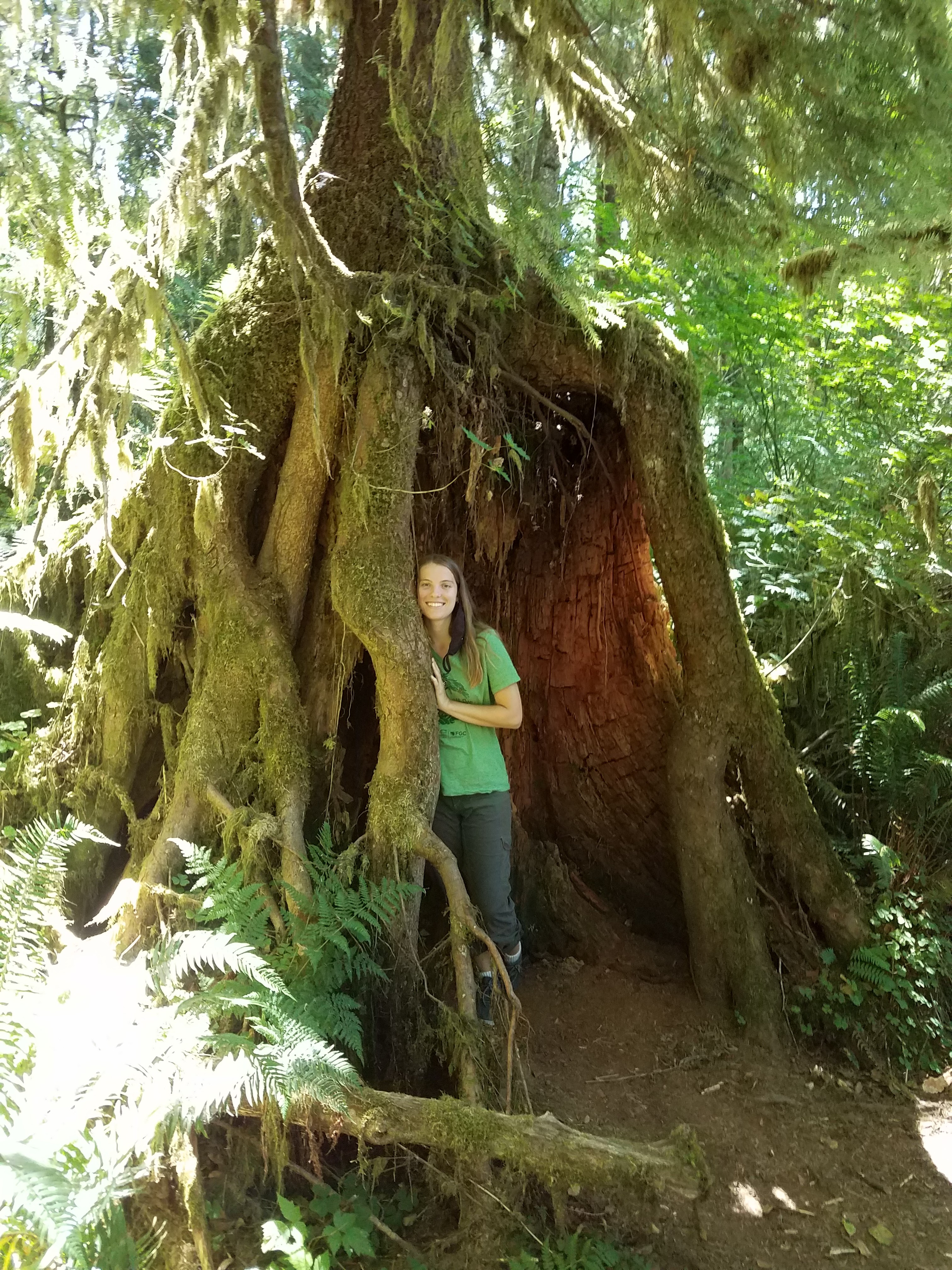
Conversion to Tree Hugger

I always appreciated that there were tree huggers and thought it unfortunate that this was used as a pejorative insult.  But I wasn't a tree hugger.   Sure I always appreciated that trees were beautiful, but that was pretty much it for me.

But then while doing my climate work I started working on protecting trees because they are carbon sinks.   This is old paradigm thinking.  It is still seeing them as things which serve humans.   But you know the simple fact that they remove greenhouse gases from the air was not enough to convince Seattle City Council members or three Mayors that we needed a new ordinance to protect them. 

However in the course of trying to convince them I learned the following things about trees:

  • They remove pollution from the air - thereby reducing asthma rates where they live
  • They are literally removing Co2 and creating oxygen for us
  • They provide enough shade to prevent "heat islands" and greatly reduce air conditioning
  • They are more effective at storm management than our technological "solutions"
  • Studies show just being able to see a tree reduces depression in humans
  • They are habitat for birds and bugs that we won't have otherwise
  • They share nutrients and communicate with each other under the earth through thin root like threads.  They look out for each other (more than I can say for many humans).
  • The older the tree the more carbon they are sequestering per year.
I started to realize that the trees were providing critical "eco-services" to us and we were taking them completely for granted.  The more I was trying to promote their protection in a city undergoing a huge building boom (and in which trees were disappearing at an alarming rate), the more I could hear the language - how others were thinking about them.  They were thinking of them as "things" and they saw them as: to be cut and used (ie as wood), as in the way (that blocks my view or I want to build there), as money to be made (board feet) or as not even as living.

How did we become so cut off from the eco system that keeps us alive that we don't understand that we are in relationship with trees?

One of my friends was talking about putting her hands on a tree and talking to it.  I was agnostic about that idea.   Then I had a really bad tree lobbying day.  I pulled up to my office where a row of 20" diameter trees head the parking lot.  I walked up to the tree and put my hands on it and said: "Mark (name changed) is ruining this for our whole group".   The tree said back to me without pause:  "Mark loves trees too."   It was a good reminder that my screwed up allie did have a common goal with me.  At the next meeting I asked us all to share before we started what our favorite tree was.  Mark broke into a broad smile and talked fondly about his feelings for Maples.   It did reconnect me to Mark. 

It has continued.  During a very upsetting meeting at my church where someone was behaving in a very toxic way I headed out in the yard and to the nearest tree.  I put my hands on the tree and said: "This is awful!"  The tree responded: "Send the toxins down into the earth like we do".     Now when I say the tree responded you may think either I am crazy or that I am anthropomorphically attributing to the tree what I want to hear (like an imaginary tree).   But all I can tell you is those are the words I heard and they were NOT at all what I expected.  If I had made up my own answers they would have been quite different (and not nearly so helpful). I was surprised how quickly the trees spoke, how they needed no time to gather there thoughts.

One of the campaigns created by a colleague to protect the trees was called Save the 6,000 (Lidar had showed that Seattle had just 6,000 exceptional trees - those over 24" in diameter left from its second growth).  For this campaign people were invited to find trees of this size in their neighborhood and take pictures of them and post them on the website for the campaign, so that we could identify where they were in order to protect them (but also to help bind people to these trees in their neighborhood).  https://www.thelast6000.org/how-you-can-help.html

I had gone with great enthusiasm to take pictures of some of my favorite trees - ones that I had lived with and stared at for a number of years.  I excitedly went to submit them on the website and then discovered that they were asking me what kind of tree it was?   What kind of tree?  Wow for a tree advocate I felt so incredibly stupid.  I did not grow up here.  I could tell you a lot of deciduous tree types in Illinois ....but here well it was good that the term Evergreen sort of covered everything.  Except that was not going to work on this website.   So I spent a lot of time looking at websites trying to figure it out.  I realized I should have paid attention to the cones which are incredibly helpful clues and also more about how the needles are on the branches.

But this interesting thing happened.  It was like you went to the same bus station every day and saw the same person till the bus got there.  Suddenly one day you start to talk and you exchange names.  They go from being a stranger to being a "real person" in your life.  Over more time maybe even a friend.   Well suddenly when I was walking past trees noticing their size and beginning to wonder their species - their name mind you, well the trees stopped being strangers in my life.  I'd already learned how amazing they were - Now I wanted to know them all by name.   That was probably the cross over point to being a bonafide tree hugger.


I have known people who have gotten arrested sitting in large trees so they would not get cut down.  In some ways I respected that they could care that much about one living being.  But in some other way it has seemed to me like focusing on one drop of water in an ocean.   Like there are so many social evils in the world, so many good causes, why not get arrested protesting a whole issue, a whole cause - something bigger.

I don't see it that way any more.   Now to be arrested with my arms wrapped around a tree protecting it feels like making a much bigger statement about needing to stand up for our eco-systems, protect the life forms that provide for us, to actually literally rejoin the Living Earth within which I am simply one breathing life form in an interdependent web of life.

As Robin Well Kimmerer says: "You cannot take something without giving back.  The tree takes care of us, so we have to take care of it."


Poem: Rushing towards Life

 Red flowering current blossoms bursting forth for Spring.  Converting Light. River rushing, gushing, over-flowing, exploding             ru...